Red Hat Linux – display system reboot
who -b

uptime
who -b uptime
Sometimes it is necessary for the database administrator to remove existing connected sessions. For example to drop a database when users and/or applications cannot (or will not) disconnect or terminate cleanly.
SELECT pg_terminate_backend(pg_stat_activity.pid)
FROM pg_stat_activity
WHERE pg_stat_activity.datname = 'database_name_with_existing_sessions'
AND pid <> pg_backend_pid();
When a SQL Server process is killed (kill spid), the non-commited work (transactions) will take a certain amount of time to roll back.
Use kill spid with statusonly to determine how much time a killed process will take to rollback
-- display rman backups
select
  j.session_recid, j.session_stamp,
  to_char(j.start_time, 'dd.mm.yyyy hh24:mi:ss') start_time,
  to_char(j.end_time, 'dd.mm.yyyy hh24:mi:ss') end_time,
  (j.output_bytes/1024/1024) output_mbytes, j.status, j.input_type,
  decode(to_char(j.start_time, 'd'), 1, 'Sunday', 2, 'Monday',
                                     3, 'Tuesday', 4, 'Wednesday',
                                     5, 'Thursday', 6, 'Friday',
                                     7, 'Saturday') dow,
  j.elapsed_seconds, j.time_taken_display,
  x.cf, x.df, x.i0, x.i1, x.l,
  ro.inst_id output_instance
from V$RMAN_BACKUP_JOB_DETAILS j
  left outer join
  (select
     d.session_recid, d.session_stamp,
     sum(case when d.controlfile_included = 'YES' then d.pieces else 0 end) CF,
     sum(case when d.controlfile_included = 'NO'
               and d.backup_type||d.incremental_level = 'D' then d.pieces else 0 end) DF,
     sum(case when d.backup_type||d.incremental_level = 'D0' then d.pieces else 0 end) I0,
     sum(case when d.backup_type||d.incremental_level = 'I1' then d.pieces else 0 end) I1,
     sum(case when d.backup_type = 'L' then d.pieces else 0 end) L
    from
     V$BACKUP_SET_DETAILS d
     join V$BACKUP_SET s on s.set_stamp = d.set_stamp and s.set_count = d.set_count
    where s.input_file_scan_only = 'NO'
    group by d.session_recid, d.session_stamp) x
    on x.session_recid = j.session_recid and x.session_stamp = j.session_stamp
  left outer join (select o.session_recid, o.session_stamp, min(inst_id) inst_id
                   from GV$RMAN_OUTPUT o
                   group by o.session_recid, o.session_stamp)
    ro on ro.session_recid = j.session_recid and ro.session_stamp = j.session_stamp
where j.start_time > trunc(sysdate)-2
order by j.start_time desc;
# java -XshowSettings:properties -version 2>&1 > /dev/null | grep 'java.home'
    java.home = /usr/lib/jvm/java-1.8.0-openjdk-1.8.0.161-0.b14.el7_4.x86_64/jre

set JAVA_HOME in ./etc/hadoop(hadoop-env.sh

From hadoop installation directory
$ ./bin/hadoop jar share/hadoop/mapreduce/hadoop-mapreduce-examples-3.0.0.jar wordcount input output

output directory should not exist before running above

-- output directories should not exist
./bin/hadoop jar ./share/hadoop/mapreduce/hadoop-mapreduce-examples-3.0.0.jar grep input output2 'dfs[a-z.]+'

./bin/hadoop jar ./share/hadoop/mapreduce/hadoop-mapreduce-examples-3.0.0.jar grep input output3 'yar[a-z.]+'
To display hidden Oracle initialization parameters:
select
  ksppinm,
  ksppstvl
from
  x$ksppi a,
  x$ksppsv b
where
  a.indx=b.indx and
  substr(ksppinm,1,1) = '_';
select
  ksppinm,
  ksppstvl
from
  x$ksppi a,
  x$ksppsv b
where
  a.indx=b.indx and
  substr(ksppinm,1,1) = '_';
See MOS: Oracle SSO account required.
My Oracle Support note 1513912.1 “TFA Collector – Tool for Enhanced Diagnostic Gathering” at https://support.oracle.com/CSP/main/article?cmd=show&type=NOT&id=1513912.1
DBCC TRACEON(2520)
DBCC HELP (‘?’)
GO

DBCC HELP(<command>)
GO
Following is the list of all the DBCC commands and their syntax. List contains all documented and undocumented DBCC commands.
DBCC activecursors [(spid)]

DBCC addextendedproc (function_name, dll_name)

DBCC addinstance (objectname, instancename)

DBCC adduserobject (name)

DBCC auditevent (eventclass, eventsubclass, success, loginname
, rolename, dbusername, loginid)

DBCC autopilot (typeid, dbid, tabid, indid, pages [,flag])

DBCC balancefactor (variance_percent)

DBCC bufcount [(number_of_buffers)]

DBCC buffer ( {‘dbname’ | dbid} [, objid [, number [, printopt={0|1|2} ] [, dirty | io | kept | rlock | ioerr | hashed ]]])

DBCC bytes ( startaddress, length )

DBCC cachestats

DBCC callfulltext

DBCC checkalloc [(‘database_name'[, NOINDEX | REPAIR])] [WITH NO_INFOMSGS[, ALL_ERRORMSGS][, ESTIMATEONLY]]

DBCC checkcatalog [(‘database_name’)] [WITH NO_INFOMSGS]

DBCC checkconstraints [( ‘tab_name’ | tab_id | ‘constraint_name’ | constraint_id )] [WITH ALL_CONSTRAINTS | ALL_ERRORMSGS]

DBCC checkdb [(‘database_name'[, NOINDEX | REPAIR])] [WITH NO_INFOMSGS[, ALL_ERRORMSGS] [, PHYSICAL_ONLY][, ESTIMATEONLY][,DBCC TABLOCK]

DBCC checkdbts (dbid, newTimestamp)]

DBCC checkfilegroup [( [ {‘filegroup_name’ | filegroup_id} ] [, NOINDEX] )] [WITH NO_INFOMSGS
[, ALL_ERRORMSGS][, PHYSICAL_ONLY][, ESTIMATEONLY][, TABLOCK]]

DBCC checkident (‘table_name'[, { NORESEED | {RESEED [, new_reseed_value] } } ] )

DBCC checkprimaryfile ( {‘FileName’} [, opt={0|1|2|3} ])

DBCC checktable (‘table_name'[, {NOINDEX | index_id | REPAIR}])
[WITH NO_INFOMSGS[, ALL_ERRORMSGS] [, PHYSICAL_ONLY][, ESTIMATEONLY][, TABLOCK]]

DBCC cleantable (‘database_name’|database_id, ‘table_name’|table_id,[batch_size])

DBCC cacheprofile [( {actionid} [, bucketid])

DBCC clearspacecaches (‘database_name’|database_id,
‘table_name’|table_id, ‘index_name’|index_id)

DBCC collectstats (on | off)

DBCC concurrencyviolation (reset | display | startlog | stoplog)

DBCC config

DBCC cursorstats ([spid [,’clear’]])

DBCC dbinfo [(‘dbname’)]

DBCC dbrecover (dbname [, IgnoreErrors])

DBCC dbreindex (‘table_name’ [, index_name [, fillfactor ]]) [WITH NO_INFOMSGS]

DBCC dbreindexall (db_name/db_id, type_bitmap)

DBCC dbrepair (‘dbname’, DROPDB [, NOINIT])

DBCC dbtable [({‘dbname’ | dbid})]

DBCC debugbreak

DBCC deleteinstance (objectname, instancename)

DBCC des [( {‘dbname’ | dbid} [, {‘objname’ | objid} ])]

DBCC detachdb [( ‘dbname’ )]

DBCC dropcleanbuffers

DBCC dropextendedproc (function_name)

DBCC dropuserobject (‘object_name’)

DBCC dumptrigger ({‘BREAK’, {0 | 1}} | ‘DISPLAY’ | {‘SET’, exception_number}
| {‘CLEAR’, exception_number})

DBCC errorlog

DBCC extentinfo [({‘database_name’| dbid | 0}
[,{‘table_name’ | table_id} [, {‘index_name’ | index_id | -1}]])]

DBCC fileheader [( {‘dbname’ | dbid} [, fileid])

DBCC fixallocation [({‘ADD’ | ‘REMOVE’},
{‘PAGE’ | ‘SINGLEPAGE’ | ‘EXTENT’ | ‘MIXEDEXTENT’}
, filenum, pagenum [, objectid, indid])

DBCC flush (‘data’ | ‘log’, dbid)

DBCC flushprocindb (database)

DBCC free dll_name (FREE)

DBCC freeproccache

dbcc freeze_io (db)

dbcc getvalue (name)

dbcc icecapquery (‘dbname’, stored_proc_name
[, #_times_to_icecap (-1 infinite, 0 turns off)])
Use ‘dbcc icecapquery (printlist)’ to see list of SP’s to profile.
Use ‘dbcc icecapquery (icecapall)’ to profile all SP’s.

dbcc incrementinstance (objectname, countername, instancename, value)

dbcc ind ( { ‘dbname’ | dbid }, { ‘objname’ | objid }, { indid | 0 | -1 | -2 } )

DBCC indexdefrag ({dbid | dbname | 0}, {tableid | tablename}, {indid |indname})

DBCC inputbuffer (spid)

DBCC invalidate_textptr (textptr)

DBCC invalidate_textptr_objid (objid)

DBCC iotrace ( { ‘dbname’ | dbid | 0 | -1 }
, { fileid | 0 }, bufsize, [ { numIOs | -1 }
[, { timeout (sec) | -1 } [, printopt={ 0 | 1 }]]] )

DBCC latch ( address [, ‘owners’] [, ‘stackdumps’])

DBCC lock ([{‘DUMPTABLE’ | ‘DUMPSTATS’ | ‘RESETSTATS’ | ‘HASH’}] |
[{‘STALLREPORTTHESHOLD’, stallthreshold}])

DBCC lockobjectschema (‘object_name’)

DBCC log ([dbid[,{0|1|2|3|4}[,[‘lsn’,'[0x]x:y:z’]|[‘numrecs’,num]|[‘xdesid’,’x:y’] |[‘extent’,’x:y’]|[‘pageid’,’x:y’]|[‘objid’,{x,’y’}]|[‘logrecs’,
{‘lop’|op}…]|[‘output’,x,[‘filename’,’x’]]…]]])

DBCC loginfo [({‘database_name’ | dbid})]

DBCC matview ({‘PERSIST’ | ‘ENDPERSIST’ | ‘FREE’ | ‘USE’ | ‘ENDUSE’})

DBCC memobjlist [(memory object)]

DBCC memorymap

DBCC memorystatus

DBCC memospy

DBCC memusage ([IDS | NAMES], [Number of rows to output])

DBCC monitorevents (‘sink’ [, ‘filter-expression’])

DBCC newalloc – please use checkalloc instead

DBCC no_textptr (table_id , max_inline)

DBCC opentran [({‘dbname’| dbid})] [WITH TABLERESULTS[,NO_INFOMSGS]]

DBCC outputbuffer (spid)

DBCC page ( {‘dbname’ | dbid}, filenum, pagenum
[, printopt={0|1|2|3} ][, cache={0|1} ])

DBCC perflog

DBCC perfmon

DBCC pglinkage (dbid, startfile, startpg, number, printopt={0|1|2}
, targetfile, targetpg, order={1|0})

DBCC pintable (database_id, table_id)

DBCC procbuf [({‘dbname’ | dbid}[, {‘objname’ | objid}
[, nbufs[, printopt = { 0 | 1 } ]]] )]

DBCC proccache

DBCC prtipage (dbid, objid, indexid [, [{{level, 0}
| {filenum, pagenum}}] [,printopt]])

DBCC pss [(uid[, spid[, printopt = { 1 | 0 }]] )]

DBCC readpage ({ dbid, ‘dbname’ }, fileid, pageid
, formatstr [, printopt = { 0 | 1} ])

DBCC rebuild_log (dbname [, filename])

DBCC renamecolumn (object_name, old_name, new_name)

DBCC resource

DBCC row_lock (dbid, tableid, set) – Not Needed

DBCC ruleoff ({ rulenum | rulestring } [, { rulenum | rulestring } ]+)

DBCC ruleon ( rulenum | rulestring } [, { rulenum | rulestring } ]+)

DBCC setcpuweight (weight)

DBCC setinstance (objectname, countername, instancename, value)

DBCC setioweight (weight)

DBCC show_statistics (‘table_name’, ‘target_name’)

DBCC showcontig (table_id | table_name [, index_id | index_name] [WITH FAST, ALL_INDEXES, TABLERESULTS [,ALL_LEVELS]])

DBCC showdbaffinity

DBCC showfilestats [(file_num)]

DBCC showoffrules

DBCC showonrules

DBCC showtableaffinity (table)

DBCC showtext (‘dbname’, {textpointer | {fileid, pageid, slotid[,option]}})

DBCC showweights

DBCC shrinkdatabase ({dbid | ‘dbname’}, [freespace_percentage
[, {NOTRUNCATE | TRUNCATEONLY}]])

DBCC shrinkfile ({fileid | ‘filename’}, [compress_size
[, {NOTRUNCATE | TRUNCATEONLY | EMPTYFILE}]])

DBCC sqlmgrstats

DBCC sqlperf (LOGSPACE)({IOSTATS | LRUSTATS | NETSTATS | RASTATS [, CLEAR]}
| {THREADS} | {LOGSPACE})

DBCC stackdump [( {uid[, spid[, ecid]} | {threadId, ‘THREADID’}] )]

DBCC tab ( dbid, objid )

DBCC tape_control {‘query’ | ‘release’}[,(‘.tape’)]

DBCC tec [( uid[, spid[, ecid]] )]

DBCC textall [({‘database_name’|database_id}[, ‘FULL’ | FAST] )]

DBCC textalloc ({‘table_name’|table_id}[, ‘FULL’ | FAST])

DBCC thaw_io (db)

DBCC traceoff [( tracenum [, tracenum … ] )]

DBCC traceon [( tracenum [, tracenum … ] )]

DBCC tracestatus (trace# [, …trace#])

DBCC unpintable (dbid, table_id)

DBCC updateusage ({‘database_name’| 0} [, ‘table_name’ [, index_id]])
[WITH [NO_INFOMSGS] [,] COUNT_ROWS]

DBCC upgradedb (db) DBCC usagegovernor (command, value)

DBCC useplan [(number_of_plan)]

DBCC useroptions DBCC wakeup (spid)

DBCC writepage ({ dbid, ‘dbname’ }, fileid, pageid, offset, length, data)

Reference : Pinal Dave (https://blog.sqlauthority.com) , BOL, Extreme Expert
PS C:\> Get-WindowsFeature RSAT-AD*

PS C:\> Install-WindowsFeature RSAT-AD-PowerShell

PS C:\> import-module ActiveDirectory

PS C:\> Get-Command Get-ADComputer

PS C:\> Get-ADComputer -Filter 'Name -like "*SQL*"'
To use Extended Events to display deadlock history, the following method can be used.
In the Object Explorer, Open Management folder
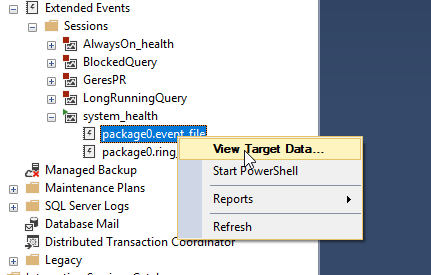
Extended Events to display deadlock history
Open Extended Events/Sessions/system_health
Right-click on package0.eventfile and select “View Target Data”. This will display a list of events.
To apply a filter, for example “deadlock”, select Filters toolbar button (may be hidden in a drop-down list)
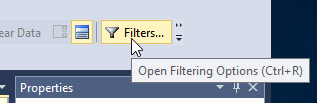
Set the filter(s)
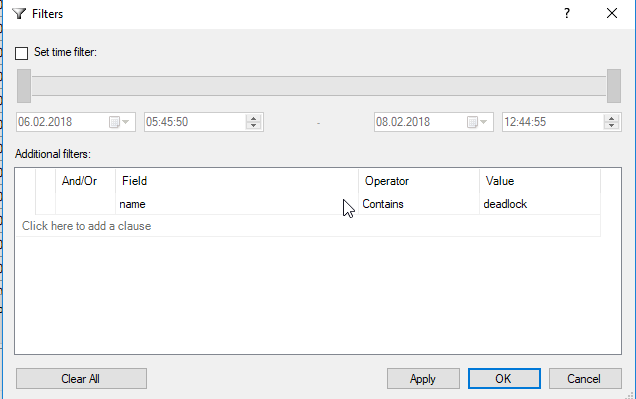
The results are displayed.
